Showing posts with label Diigo. Show all posts
Showing posts with label Diigo. Show all posts
Saturday, November 17, 2012
Diigo: Week 10
This week I added a few new articles to my public Diigo library. Each article is about a different topic but all are meant to get you thinking about the future of education in your schools and in regards to professional development. Check them out!

Monday, November 5, 2012
Diigo: Week 9: Educational Technology Edition
This week I read a few articles that have to do with topics relating to education technology that I have recently discussed.
ASCD published an article regarding the BYOD (bring your own device) trend in technologically driven schools, a phenomena discussed in the webinar discussing Carpe Diem and St. Mary's.
The New York Times published yet another article regarding the ever expanding and developing web-services for free, online college level courses like Corsera, Udacity, and edX, now known as massive open online courses (MOOCs).
The New York Times also published an article regarding how technology (for entertainment and research) may affect not only student’s attention spans, but the ways teachers must teacher in order to reach students and keep them engaged. Some teachers are unwilling make their lessons more entertaining for the sake of reaching students who are driven by the (instant) gratification of virtual realities and search engine research. However, these teachers are finding themselves offering more one-on-one instruction to address students’ declining communication skills. Other teachers see that they must change their lessons simply in order to adapt to a new generation of students.
Learn more about these topics by accessing these articles and others through my Public Diigo Library.
Monday, October 29, 2012
Diigo: Week 8: Technology Edition
This week, the materials added to my public Diigo library are related to technology. It has been customary for me to add news articles from sources such as The New York Times and CNN. While I did add a couple articles this week, I also wanted to share news related to a new technological feature and resource; I added a blog post from Google's official blog and a website.
As an undergraduate I studied earth science and oceanography. I'm crossing my fingers that I get to teach fifth grade earth and space systems which focuses on concepts regarding the ocean environment. I have tested and investigated many resources for a fifth grade oceanography unit and by far, my favorite has been Google Earth's underwater feature. I love the idea of taking students on a virtual tour of the seafloor!
Last year I learned about a project, known as the Catlin Seaview Survey, being conducted that would provide panoramic views of the Great Barrier Reef. These images were given to Google for use in Google Earth. In addition, by visiting the website for the Catlin Seavew Survey project, one has access to virtual tours of the Great Barrier Reef, information about the various locations were footage was taken, and more information about the project itself. For more information about Google's and the project's partnership and for a link to the website, visit my public Diigo library.
Next, I found an article written regarding the length of a high school education at one technologically based school. To find out why students are entering a lottery to attend this school for six years instead of four and visit my public Diigo library!
Finally, I found an article written regarding creating a fake identity for online safety. While this may not be something that I would encourage my students to do, the topic of internet safety is an essential part of the technology curriculum for every class at every grade. There are always new risks that shouldn't be taken and new ways to protect yourself; teachers should stay vigilant and share this information with their students. Since I have been required to create many accounts through this course, I figured it would be smart to investigate this internet safety tactic for myself. Visit my public Diigo library to stay informed!
As an undergraduate I studied earth science and oceanography. I'm crossing my fingers that I get to teach fifth grade earth and space systems which focuses on concepts regarding the ocean environment. I have tested and investigated many resources for a fifth grade oceanography unit and by far, my favorite has been Google Earth's underwater feature. I love the idea of taking students on a virtual tour of the seafloor!
Last year I learned about a project, known as the Catlin Seaview Survey, being conducted that would provide panoramic views of the Great Barrier Reef. These images were given to Google for use in Google Earth. In addition, by visiting the website for the Catlin Seavew Survey project, one has access to virtual tours of the Great Barrier Reef, information about the various locations were footage was taken, and more information about the project itself. For more information about Google's and the project's partnership and for a link to the website, visit my public Diigo library.
Next, I found an article written regarding the length of a high school education at one technologically based school. To find out why students are entering a lottery to attend this school for six years instead of four and visit my public Diigo library!
Finally, I found an article written regarding creating a fake identity for online safety. While this may not be something that I would encourage my students to do, the topic of internet safety is an essential part of the technology curriculum for every class at every grade. There are always new risks that shouldn't be taken and new ways to protect yourself; teachers should stay vigilant and share this information with their students. Since I have been required to create many accounts through this course, I figured it would be smart to investigate this internet safety tactic for myself. Visit my public Diigo library to stay informed!
Monday, October 22, 2012
Diigo: Week 7: Full Day Kindergarten Edition
Summary
This week, I'm working on a research project/presentation regarding the pros and cons of full day kindergarten. I was interested in finding articles that related to local schools' movement to full day kindergarten.
What I Learned
Elementary schools throughout Fairfax County, Virginia began instituting full day kindergarten for every kindergartener as of 2011. However, they have been offering some full day kindergarten programs for at-risk students since 1990.Loudoun County, Virginia is interested in implementing full-day kindergarten but have found that a significant amount of construction will need to be done in preparation. They have drawn a construction proposal that compares the cost of modular construction to building additions. However, the school board found that there is simply no room in the FY13 budget for this development. Loudoun County currently offers 9 full-day kindergarden programs for current PreK and at-risk students.
Frederick County, Virginia is working to develop full day kindergarten begining in 2013. While they do not have the budget to institute programs county wide, they have been granted room in the school budget for additions to several elementary school. It is said that this money will enable the county to begin working towards offering full day kindergarten.
To read more about concerns over full day kindergarten read over my new article finds in my Public Diigo Library.
What is your opinion regarding half day and full day kindergarten?
Tuesday, October 16, 2012
Diigo: Week 6: Standardized Testing Edition
Standardized testing is always a hot topic in educational news. Usually I find articles o standardized testing to be from the same old, depressing point of view. But, this week, I read three articles, each focused on a unique issue and with a different perspective.
This week, one individual told me that she keeps her children home during testing time. To this comment, a colleague remarked, "You can do that?" How radical right? Well it turns out that a significant number of families in New York school systems are keeping their children at home during field tests of the new Common Core Curriculum test questions. As the standards have changed in this state, new tests need to be administered. Twice a year, students are required to take field tests to determine the quality of drafted test questions. These same families however, do not feel they can take the risk of keeping their children at home on the day the official test is administered as it would likely impact the chances of student promotion for the following school year. (New York Times)
But what happens when an administrator persuade high school students to stay home on testing day? The answer: they are arrested and fined. One superintendent in El Paso, Texas is being accused of removing low achieving students from the tenth grade--sending them home, holding them back, promoting them to eleventh grade--to avoid having them take a standardized test in order to show higher passing rates for monetary gain. Families and students accuse this man of influencing higher student drop out rates as well; if their not good enough to be in school on testing day, why should the go to school at all? (New York Times)
Standardized testing may cause more harm than good you may say; however, there are scholars that con look past student distress and see the benefits of analyzing student learning potential and progress. Some of these scholars say that the standardized tests administered in most states aren't enough, that we could be and should be testing students in kindergarten. Doing so would allow teachers and administrators to respond sooner with early intervention and to assess which students will need more extensive support throughout the school years. (Education News)
Who will win, the scholars, the administrators, or the parents/students?
Read these articles and others from the week in my Public Diigo Library.
This week, one individual told me that she keeps her children home during testing time. To this comment, a colleague remarked, "You can do that?" How radical right? Well it turns out that a significant number of families in New York school systems are keeping their children at home during field tests of the new Common Core Curriculum test questions. As the standards have changed in this state, new tests need to be administered. Twice a year, students are required to take field tests to determine the quality of drafted test questions. These same families however, do not feel they can take the risk of keeping their children at home on the day the official test is administered as it would likely impact the chances of student promotion for the following school year. (New York Times)
But what happens when an administrator persuade high school students to stay home on testing day? The answer: they are arrested and fined. One superintendent in El Paso, Texas is being accused of removing low achieving students from the tenth grade--sending them home, holding them back, promoting them to eleventh grade--to avoid having them take a standardized test in order to show higher passing rates for monetary gain. Families and students accuse this man of influencing higher student drop out rates as well; if their not good enough to be in school on testing day, why should the go to school at all? (New York Times)
Standardized testing may cause more harm than good you may say; however, there are scholars that con look past student distress and see the benefits of analyzing student learning potential and progress. Some of these scholars say that the standardized tests administered in most states aren't enough, that we could be and should be testing students in kindergarten. Doing so would allow teachers and administrators to respond sooner with early intervention and to assess which students will need more extensive support throughout the school years. (Education News)
Who will win, the scholars, the administrators, or the parents/students?
Read these articles and others from the week in my Public Diigo Library.
Wednesday, October 10, 2012
Diigo: Week 5
My Public Diigo Library has just been updated. The New York Times has reported on some very interesting issues in education this week including a couple articles related to technology in the classroom. I've highlighted the heck out of a few that appealed to my logic, emotions, and personal ethics. Put on your thinking caps, grab some tissues, consult your coincence, and check out my library.
Sunday, September 30, 2012
Diigo: Week 4
Here are the highlights from the news articles I added to my public Diigo Library this week.
Stuyvesant Students Describe Rationale for Cheating - NYTimes.com
This article provides some insite into why students cheat and how they justify it.
Parents Pitch In to Help Texas Schools Face Budget Cuts - NYTimes.com
A public school in Texas has a new outdoor classroom thanks to parents and other volunteers. But has this created inequality in the public school system?
Feedback for Learning:Seven Keys to Effective Feedback-ASCD
What is feedback and how does it influence student learning and achievement?
Check out my public Diigo Library.
Stuyvesant Students Describe Rationale for Cheating - NYTimes.com
This article provides some insite into why students cheat and how they justify it.
Parents Pitch In to Help Texas Schools Face Budget Cuts - NYTimes.com
A public school in Texas has a new outdoor classroom thanks to parents and other volunteers. But has this created inequality in the public school system?
Feedback for Learning:Seven Keys to Effective Feedback-ASCD
What is feedback and how does it influence student learning and achievement?
Check out my public Diigo Library.
Monday, September 24, 2012
Diigo: Week 3
I have added three new articles to my Diigo Library. Here is a highlight of the articles for this week.
The Myth of the Culture of Poverty by Paul Gorski-ASCD.org
Students from low-income families are being stereotyped by teachers. This article lists some of the common beliefs about parents and students living in poverty and offers insight into the realities of their struggles. With this information, teachers may better understand how to reach these individuals.
Education Site Expands Slate of Universities and Courses by Tamar Lewin-NYTimes.com
Coursera expands to include more partners and more courses.
Newark Eyes Merit Pay for Teachers by Lisa Fleisher-CNN.com
A few states in the U.S. have instituted merit pay for teachers but for NJ, Newark's negotiations with the state's infamous teachers union may bring groundbreaking change.
Check out my Public Diigo Library.
The Myth of the Culture of Poverty by Paul Gorski-ASCD.org
Students from low-income families are being stereotyped by teachers. This article lists some of the common beliefs about parents and students living in poverty and offers insight into the realities of their struggles. With this information, teachers may better understand how to reach these individuals.
Education Site Expands Slate of Universities and Courses by Tamar Lewin-NYTimes.com
Coursera expands to include more partners and more courses.
Newark Eyes Merit Pay for Teachers by Lisa Fleisher-CNN.com
A few states in the U.S. have instituted merit pay for teachers but for NJ, Newark's negotiations with the state's infamous teachers union may bring groundbreaking change.
Check out my Public Diigo Library.
Monday, September 17, 2012
Diigo Library Update: Week 2
I have just added three new stories/articles to my Diigo library. Here is an overview.
NYTimes.com
Fellowships that encourage smart students to pursue knowledge and forgo the college experience in order by tackling authentic applications that will get the job done.
CNN.com
When children receive things from other, they are othen made happy for a time. But, may the process of giving lead to both immediate and long-term happiness in children's lives.
U.S.News.nbcnews.com
Michelle Rhee comments on Obama's "Race to the Top" program and Romney's ideas regarding local level control on education and vouchers for low-income studnts.
To access my public Diigo library, click here.
NYTimes.com
Fellowships that encourage smart students to pursue knowledge and forgo the college experience in order by tackling authentic applications that will get the job done.
CNN.com
When children receive things from other, they are othen made happy for a time. But, may the process of giving lead to both immediate and long-term happiness in children's lives.
U.S.News.nbcnews.com
Michelle Rhee comments on Obama's "Race to the Top" program and Romney's ideas regarding local level control on education and vouchers for low-income studnts.
To access my public Diigo library, click here.
Sunday, September 9, 2012
Social Bookmarking: Diigo
Summary
All Internet browsers allow users to save, organize, and gain easy access
to their favorite websites but Web 2.0
technology has combined bookmarking
with social networking to bring
Internet users social bookmarking.
One such social bookmarking site, Diigo, provides a browser add-on, allowing users to highlight, comment, bookmark, and share (through facebook, twitter, and
email) webpages and online articles. But, that only describes its bookmarking
capabilities. Diigo provides an online
library where bookmarks are stored. This library can be accessed by the
public, other Diigo users, or by friends (depending upon the user’s privacy
settings). Diigo makes bookmarking social by connecting users with content and people based on location,
language, and content preferences. Groups can be created through which “members”
can collect and share digital information for a common goal: to provide
resources, to inform, to open discussion, etc.
What
I Did
A user can decide how
extensively they which to make use of Diigo’s services. Diigo’s website offers
videos for general information and tutorials to get you started. Before I began
using the site I viewed this Youtube video
which introduced me to Diigo’s most basic features and encouraged me to use its
more social features for a greater experience.
To get started, the video recommended 1) using the
browser add-on to highlight and annotate online articles, 2) using the add-on
to bookmark those articles and tag
them using keywords, and 3) using the personal library to organize bookmarks in
lists.
To use the site’s more extensive features, the video
recommended 1) checking out what Diigo friends are interested in, what
interests are shared in common, 2) messaging Diigo friends and 3) participating
in groups.
After registering for Diigo, I updated my profile,
setting preferences that will allow Diigo to make suggestions for me, I
adjusted my settings to provide me with a comfortable level of security, and I
began searching for interesting articles to read online. Once I found an
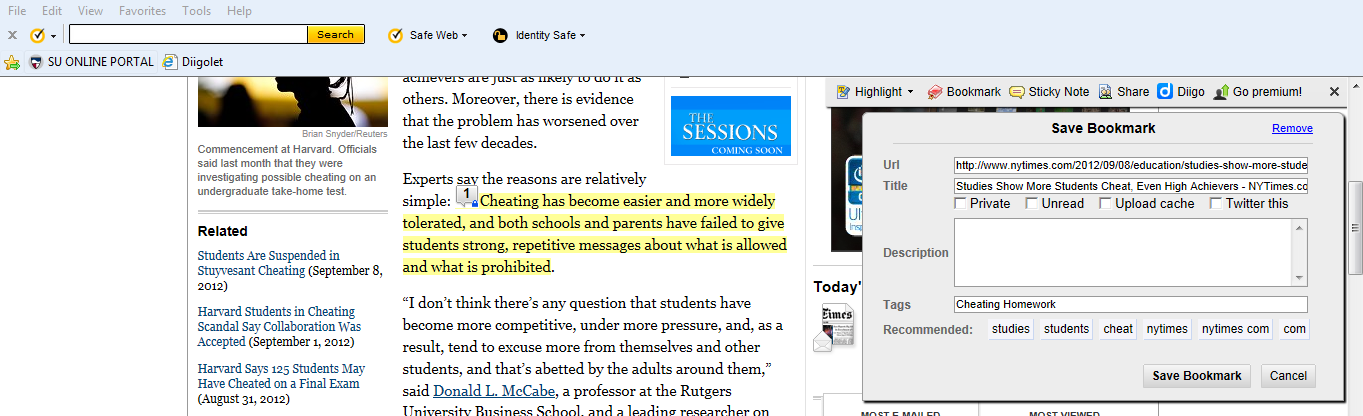
interesting article, I clicked on the Diigolet add-on, I clicked on bookmark which
allowed me to add a title, description, and tags. Then I highlighted and added
comments throughout the article to sections I found particularly important or
intriguing. I went into my Diigo library. I was interested to see that
not only did the title of the article, its description, and its tags appear,
but everything that I highlighted and all of my comments appeared as well.

The ability to see these things, I believe, makes the tool very valuable although, I think that as I add more articles, the page will become difficult to look at and sort through. It seems that the list feature may come in handy to midigate this problem.

The ability to see these things, I believe, makes the tool very valuable although, I think that as I add more articles, the page will become difficult to look at and sort through. It seems that the list feature may come in handy to midigate this problem.
To see my public Diigo library click here.
Q&A
What is Web 2.0?
Web 2.0 is different from previous stages of the
web as it is based on user generated content as opposed to serving content
created for users. Web 2.0 combines social
media and publishing techniques in ways that enable users to collaborate in
virtual communities with the purpose of sharing information.
What is social bookmarking?
Social bookmarking sites are for Internet users to
acquire, archive, tag, and share online resources within an online community.
What are advantages to social bookmarking?
The World Wide Web expands by the second. Somewhere
online is the relevant, informational, or interesting resource I’ve been
looking for. Once I find it by sifting through all the sites that don’t meet my
criteria, instead of keeping it to myself, I can
share this resource with others through social bookmarking. The process of online research is then
streamlined for others who have the same interests and needs that I do.
What is a browser add-on and why are they useful?
Browser add-ons are tools that appear in one’s
Internet browser that provide additional functionalities for online sites and applications
such as Amazon’s “Add to Wish List” button. They are allow popular websites to be used in effective and efficient ways that work for the user.
What browser do you use?
Internet Explorer.
What is your experience with browser add-ons?
I have had very little experience with browser add-ons.
Did you get your add on to work?
Yes.
What browser add-ons are you currently using?
Internet Explorer Bookmark, Diigo, Norton Security.
How
I Would Use It
Age restrictions apply to many social media sites
and their use is therefore inappropriate in schools. For this assignment, I read an article that suggests this tool may motivate school age students to read and encourage them to participate in discussions about readings. This may be true for
high school students but I would be weary of using such technology (parent
permission would be required) and it certainly has no place in the elementary
classroom. However, if used by staff and faculty within a school system, professional
development would be put on a fast track. Online resources for classroom use
and recent research in the field could be shared and debates could be raised
over important issues through a Diigo group by colleagues.
Standards
Reflection
A
teacher using Diigo would be meeting Standard
5 of the ISTE-NETS-T standards,
particularly sections a, c, and d. When teachers communicate and share ideas regarding
teaching and learning with others through Diigo, especially when networking in
a group, they are teaching and learning in a virtual place with multiple communities.
As they research articles and read articles found by others, they are thinking
critically about information that could influence their practices in the
classroom. If teachers in a school or school system participate and collaborate
within a Diigo group, they are promoting the modern advancement of their
school community and classrooms.
Subscribe to:
Posts (Atom)